Why America Can No Longer Ignore Men’s Health:
Responding to the Growing Call for a Federal Men’s Health Strategy
From the Lifespan Gender Gap to H.R. 7602, a national conversation around preventive care, public health, and healthcare access for men continues gaining momentum.
Dominick Shattuck’s recent Substack article, “Why the U.S. Needs a Federal Strategy on Men’s Health,” arrives at an important moment in the growing national conversation around men’s health, preventive care, and public health policy. As both a public health researcher and a member of the Men’s Health Network Advisory Board, Dr. Shattuck continues helping elevate an issue that has too often remained overlooked within larger healthcare conversations.
His article, published on Substack in April 2026, lays out a direct but necessary argument: the United States can no longer ignore the measurable and preventable disparities impacting men’s health outcomes. Read the original Substack article here
At the center of the article is a reality MHN has discussed for decades:
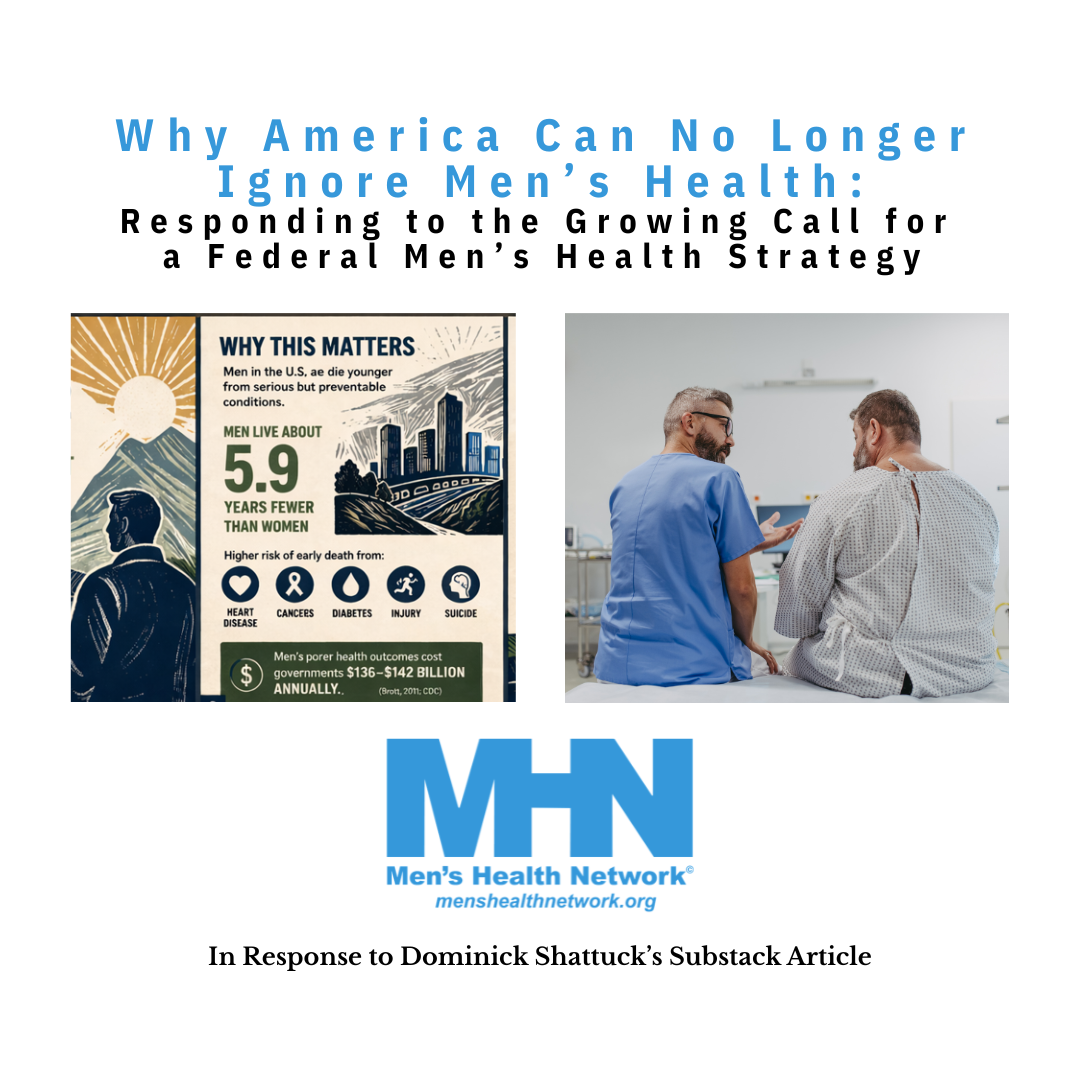
“Men in the United States are dying younger than women — by nearly six years on average — and much of that gap is driven by preventable conditions.”
That statement alone should fundamentally reshape how we discuss men’s health in America.
For many people, the “Lifespan Gender Gap” still comes as a surprise. Yet the data has remained remarkably consistent for years. Men continue to experience disproportionately high rates of cardiovascular disease, suicide, workplace injury, substance misuse, diabetes complications, and certain cancers. At the same time, men are significantly less likely to engage with preventive healthcare systems early enough to catch problems before they become severe.
This is not simply an individual responsibility issue.
As Dr. Shattuck points out, many barriers are structural:
“Structural, economic, and geographic factors shape access to care, while medical mistrust, stigma, and norms around self-reliance can delay help-seeking.”
That framing matters.
Too often, conversations surrounding men’s health become reduced to simplistic stereotypes: “men don’t go to the doctor,” “men ignore symptoms,” or “men need to take better care of themselves.” While personal responsibility certainly matters, reducing complex public health disparities to personal choice ignores the larger systems-level challenges influencing health outcomes.
Many healthcare environments were not built with men’s patterns of healthcare engagement in mind. Men frequently interact with healthcare differently than women do. They may lack routine touchpoints that encourage consistent preventive care engagement across the lifespan. They may delay care due to work obligations, financial pressure, caregiving responsibilities, cultural expectations around toughness, or fear of appearing vulnerable.
In many cases, men are taught from a young age to “push through” discomfort, exhaustion, emotional distress, or physical symptoms until those symptoms become impossible to ignore.
That delay can become deadly.
The broader public health implications extend far beyond the individual.
When men experience worsening health outcomes, families feel it. Partners feel it. Children feel it. Employers feel it. Communities feel it.
Dr. Shattuck’s article does an effective job reframing men’s health not as a niche issue, but as a workforce issue, a family issue, and a public health issue.
That framing closely aligns with the broader advocacy direction MHN has increasingly emphasized through its “health empathy” messaging and “Partners in Care” campaigns. Improving men’s health outcomes does not compete with women’s health or family health priorities. In reality, these outcomes are deeply interconnected.
One of the most important sections of the article focuses on H.R. 7602, the State of Men’s Health Act.
Read H.R. 7602 here on Congress.gov
As described in the article:
“The proposed H.R. 7602 — State of Men’s Health Act offers a pragmatic starting point.”
The legislation would require a national study assessing the state of men’s health in the United States while evaluating disparities, gaps in care, and the effectiveness of existing federal programs. It would also establish an Office of Men’s Health within the Department of Health and Human Services to help coordinate prevention, screening, education, and awareness initiatives.
Importantly, the legislation explicitly states that it does not reduce or compete with existing women’s health funding.
That clarification matters because one of the greatest barriers to advancing men’s health conversations has been the false perception that discussing men’s health somehow detracts from women’s health advocacy.
It does not.
Public health should never operate as a zero-sum conversation.
The reality is that many health systems already recognize the value of targeted approaches to population health. Women’s health offices, minority health initiatives, rural health initiatives, and disease-specific programs exist because healthcare outcomes improve when systems recognize and respond to the specific needs, risks, behaviors, and barriers experienced by different populations.
Men’s health deserves the same seriousness.
This is especially important as multiple health trends continue moving in troubling directions.
Younger men are increasingly experiencing chronic disease risk factors earlier in life. Mental health challenges continue escalating. Suicide rates remain disproportionately high among men. Colorectal cancer rates are rising among younger adults. Sleep apnea, cardiovascular disease, hypertension, loneliness, social isolation, and delayed preventive care continue affecting millions of households nationwide.
And yet, despite these realities, men’s health often remains fragmented across policy discussions rather than addressed through coordinated national strategy.
One of the strongest aspects of Dr. Shattuck’s piece is that it avoids sensationalism. Instead, it frames the issue through evidence, systems-thinking, and pragmatic policy development.
That tone is important.
Men’s health advocacy should not rely on outrage or division. It should rely on data, public health outcomes, preventive care improvements, and stronger engagement strategies that help men live longer, healthier lives.
The article also highlights another important reality:
Trust.
Plain and simple.
Medical mistrust, stigma, discrimination, and negative healthcare experiences can all influence whether men seek care early or disengage from systems entirely. This is particularly true among underserved populations, rural communities, working-class men, minority populations, veterans, and men experiencing financial instability or social stressors.
Public health conversations must acknowledge these realities honestly if meaningful progress is going to occur.
As MHN has consistently emphasized throughout its educational campaigns, awareness alone is not enough. Systems must also become more accessible, proactive, and engaging.
That includes:
- Earlier preventive screening conversations
- More accessible healthcare environments
- Better mental health engagement strategies for men
- Community-centered outreach
- Workplace wellness engagement
- Public awareness campaigns that reduce stigma
- More research focused specifically on men’s health outcomes
- Better integration between physical health and emotional health conversations
The article’s concluding point may be its most important:
“The question is no longer whether these disparities exist. It is whether policy will respond to them.”
That question now sits at the center of a growing national conversation.
Over the past several years, momentum surrounding men’s health policy has steadily increased across federal and state levels. Conversations around preventive screening access, prostate cancer legislation, workplace health, mental health, fatherhood, caregiving, and healthcare access are becoming more visible than they were even a decade ago.
At the same time, organizations like Men’s Health Network continue helping bridge conversations between researchers, policymakers, clinicians, community leaders, healthcare systems, advocates, and families.
That collaborative approach matters because men’s health does not exist in isolation.
Healthier men often mean healthier families, stronger communities, greater workforce participation, reduced healthcare costs, and improved long-term public health outcomes overall.
The conversation is no longer simply about whether men experience disparities.
The data already answers that question.
The real question is whether healthcare systems, policymakers, institutions, and communities are prepared to respond with the same seriousness, coordination, empathy, and urgency that other major public health challenges receive.
About the Author
Dominick Shattuck is a public health researcher, educator, and advocate whose work focuses on global health, preventive care, health equity, and improving health outcomes among underserved populations. His research and public health efforts have explored issues related to healthcare access, behavioral health, HIV prevention, implementation science, and the social and structural factors that influence long-term health outcomes.
Dr. Shattuck’s article helps push that conversation forward thoughtfully, responsibly, and with the kind of public health framing this issue deserves.
Dr. Shattuck serves as a member of the Men’s Health Network Advisory Board, where he contributes to broader conversations surrounding men’s health policy, preventive care, public health strategy, and healthcare engagement. Through his writing and advocacy, he continues helping raise awareness around the importance of addressing the Lifespan Gender Gap, strengthening preventive healthcare systems, and advancing evidence-based approaches to improving men’s health outcomes across the United States.