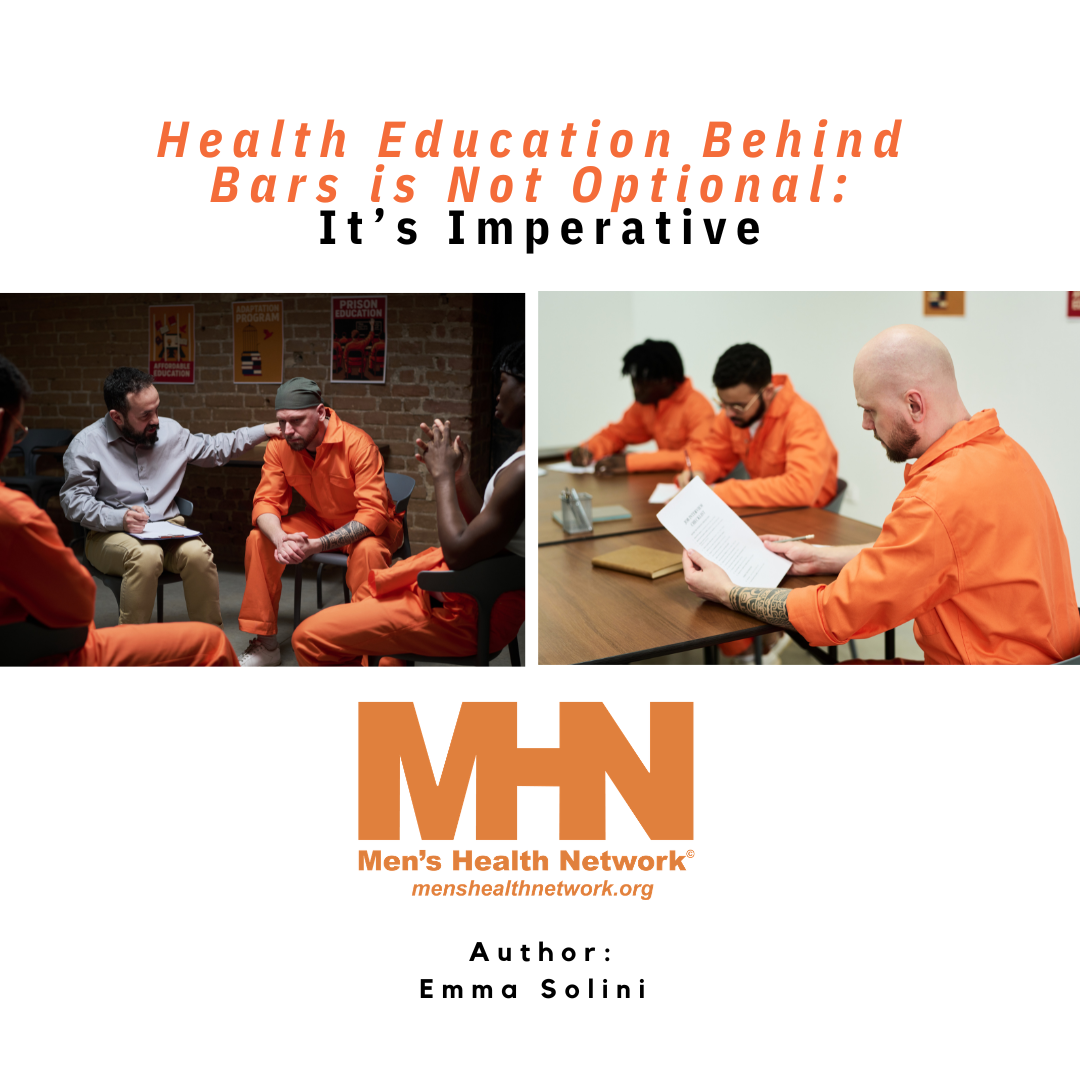
Health Education Behind Bars is Not Optional:
It’s Imperative
Advocacy OP-ED
Author: Emma Solini
More than one million men in the United States wake up each day inside of a prison facility.
These men are our fathers, sons, brothers, and they are disproportionately being affected by chronic illnesses, untreated / unmanaged mental health and substance use disorders and they have limited access to preventive care. Health education programs and prevention services are the most basic and cost-effective solutions for them and yet it is rarely implemented and oftentimes overlooked.
To achieve better public health results for men throughout the United States we need to include incarcerated males in these efforts, because health education within prison facilities is a necessity if we want to make an impactful investment into health and benefit our overall society Incarcerated men experience higher rates of hypertension, diabetes, cardiovascular disease, infectious disease exposures, and mental health struggles compared to that of the general male population.
Many men who enter a correctional facility already have experienced several years of unmanaged medical illness, disruptions in their treatment, financial struggles and / or little to no access to preventive care measures. Further for young boys in juvenile correctional facilities the educational interruptions and early traumatic experiences create long term health risks.
Due to the large number of men within prisons, by default correctional facilities have become one of the largest health service providers for low income men in the country.
Despite this fact, too often care focuses solely on responding to treatment in times of crisis rather than prevention.
These facilities may supply medication but their inmate patients lack the health literacy and essential knowledge that would enable them to handle their chronic illnesses, identify the health problems they are having, and understand healthcare structure so they can make informed decisions when it comes to their treatment.
The results of this lack of knowledge is apparent when we see the majority of recently released inmates in hospitals and emergency rooms days after their release.
These outcomes are costly not just to these men but to the communities and health systems as a whole.
The issues of inadequate healthcare and unmanaged health conditions within these prisons do not stop at the gate, but rather they return to their communities.
Men who have just been released are at a higher risk of overdose, cardiac episodes, and mental health breakdowns during the first month outside prison.
This alone shows that the transition period has weak points in its continuity of care. Health education programs teach men how to take their medications properly , undergo preventive tests, and schedule appointments which all lead to better health among this population and a reduction in the utilization of emergency services. This should matter to policymakers seeing as preventive education reduces the downstream health costs and will strengthen reentry. Therefore we can see that health education within prisons does not only serve as a basic human right but also as a financial savings outcome.
Critics may ask if expanding health programs within correctional facilities risks the creation of coercive environments, one where participation in these programs is not voluntary but required or used as a disciplinary tool. These are serious concerns and deserve a lot of attention to ensure this is not the case.
Prisons create high stress environments and their design limits the movement and activities these inmates can participate in, which is why it is imperative that ethical safeguards are explicit. Health education participation from incarcerated men needs to be voluntary and it should clearly be separated from any disciplinary functions.
The decision to participate should also not impact anyone’s status or privileges seeing as that would defeat the whole purpose of implementing these programs to begin with. Further the collection of data needs to adhere to certain ethical and transparency standards, that way the information cannot be tied back to the inmates and it cannot be used against them (especially if they did not end up benefiting from / enjoying the program).
Additionally seeing as many of these men have gone through several traumatic life events making participation voluntary would allow them to opt-out should there be a sensitive topic they do not wish to sit in on. Implementing these safeguards is an essential requirement for the organization and ethical research practices need to be created to set intentional boundaries between health education and enforcement.
The main purpose of health education programs is to benefit male inmates as opposed to serving as institutional needs for public display.
Men in general already underutilize healthcare services and have a shorter life expectancy compared to women.
Incarcerated men are as such an extremely disadvantaged group within this larger population and their absence in men’s health strategies has created a permanent gap. Health equity requires attention to all populations. The majority of incarcerated men and boys come from economically and educationally disadvantaged communities and admittance into a correctional facility does not help this disruption, however preventive education within these facilities can help to interrupt this cycle of education disruption and lack of health literacy. Especially in the case of young boys in juvenile facilities, early intervention education programs can have impactful outcomes.
Expanding health education into correctional facilities should not be treated as a political matter or a way to support prison policy initiatives. This solution is a public health measure that will establish preventive health programs through scientific foundations.
These programs would do well to improve the oversight issues many prisons have been having, as well as demonstrate their commitment to the continuity of care among prisoners.
The main purpose of health education is prisons is centered around restoring human dignity while enforcing this social responsibility we have. The program acknowledges that incarcerated men, although behind bars at the moment, are in fact a part of our society and therefore deserve the basic human rights that are afforded to everyone else in the general population.
This program would recognize that prevention is more effective than simply responding to a crisis and it reflects a certain dedication to achieving measurable results instead of symbolic gestures.
The implementation of this operation would require transparency, voluntariness, safeguards and it should also prioritize inmate benefit. When done right this is a no brainer this is a responsible measure to be taken not a radical one.
If we are willing to invest in health education into schools, workforces, community centers what is stopping us from investing in our male inmate population where health disparities are disproportionately concentrated. Public health policy needs to include all people regardless of their status, and the choice to ignore this opportunity is a failure on our part as human beings.
This perpetuates harm that could have easily been prevented and we need to do better.
About the Author:

Emma Solini is a Master of Public Policy student at George Mason University where she specializes in economics and health policy. Her interest in public policy grew from her background in sociology where she became interested in how economic and social systems can influence health outcomes, which is what ultimately led her to explore work focusing on reducing disparities. She is currently focusing on initiatives aimed at expanding health education and preventive care for incarcerated populations. She is especially interested in the healthcare policy, economic development, and using data-driven approaches to inform policy solutions.