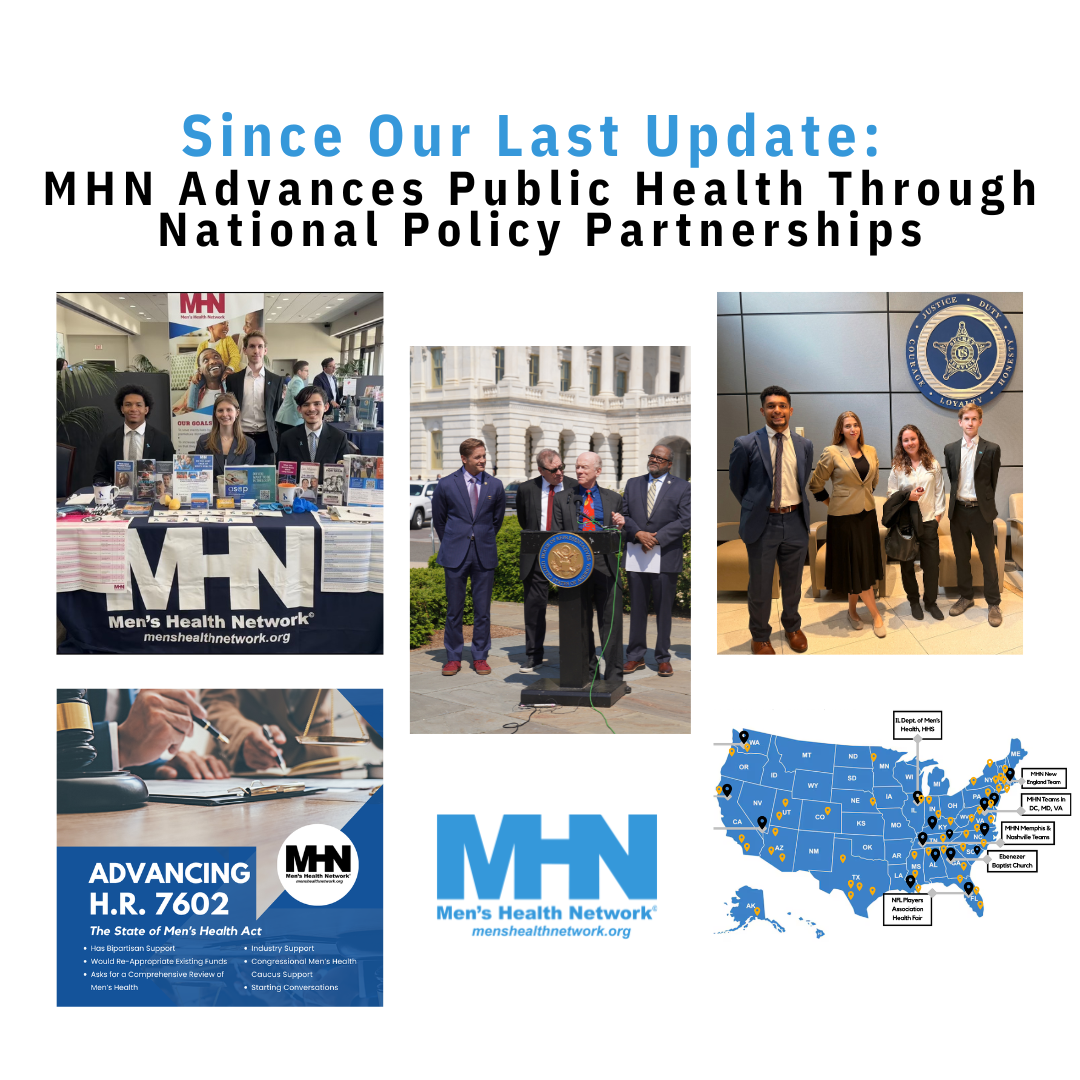
Since Our Last Update:
Men’s Health Network Advances Public Health Through National Policy Partnerships
Public policy is often built with one conversation, one coalition, and one letter at a time.
Since our last policy update, Men’s Health Network (MHN) has continued working alongside many of the nation’s leading medical societies, patient advocacy organizations, public health groups, and research organizations to support policies that improve health outcomes for men, boys, and their families. While many of these efforts may not make national headlines, they represent meaningful opportunities to influence federal agencies, strengthen medical research, improve patient safety, and remove barriers to quality healthcare.
One of the greatest strengths of the public health community is collaboration. When organizations representing millions of patients speak with one voice, policymakers are more likely to listen. Over the past several months, MHN has joined numerous coalition letters and national advocacy efforts addressing clinical trials, pharmaceutical safety, military medical research, prostate cancer, and men’s health policy.
Here’s a look at some of the important work taking place across the public health landscape.
—
Helping More Patients Participate in Clinical Trials
One of the most significant coalition efforts we recently supported focused on making clinical trials more accessible for patients facing serious illnesses.
MHN joined nearly 200 national organizations in supporting efforts led by the American Cancer Society Cancer Action Network (ACS CAN) to encourage the U.S. Department of Health and Human Services (HHS) to reduce financial barriers that prevent patients from participating in clinical research.
For many patients, especially those living with cancer and other life-threatening diseases, participating in a clinical trial can involve substantial indirect expenses. Travel, lodging, meals, parking, childcare, and lost wages often become barriers that make participation impossible, even when promising treatment may be available.
As ACS CAN noted in its announcement:
“Cancer patients who want to enroll in clinical trials face what can be significant expenses related to costs like travel, parking, lodging, childcare and lost wages incurred as a result of attending appointments related to the clinical trial.”
The coalition supports creating a safe harbor under the federal Anti-Kickback Statute that would allow clinical trial sponsors to help offset these indirect costs without creating legal concerns.
This may sound like a technical regulatory issue, but the impact is very personal. Every barrier removed creates another opportunity for patients to access innovative treatments while helping researchers develop tomorrow’s standards of care.
MHN was proud to stand alongside organizations representing cancer patients, physicians, nurses, researchers, pharmacists, mental health advocates, and many others in supporting this important effort.
—
Supporting Patient Safety in the Growing GLP-1 Marketplace
Another recent coalition effort focused on protecting patients as the popularity of GLP-1 medications for diabetes and obesity continues to grow.
MHN joined patient advocacy, public health, consumer protection, and chronic disease organizations in supporting the Food and Drug Administration’s proposed decision not to add semaglutide, tirzepatide, and liraglutide to the FDA’s 503B Bulk List.
The issue centers on compounded versions of these medications. While pharmaceutical compounding serves an important role when a patient’s medical needs cannot be met by an FDA-approved medication, coalition members believe routine large-scale compounding should remain the exception, not the rule, when approved medications are available.
The coalition letter explains:
“Compounding should remain a carefully limited exception, not a routine substitute for approved therapies.”
Protecting patients means ensuring they understand the difference between FDA-approved medications and compounded alternatives while preserving confidence in the nation’s drug approval process.
This position was further reinforced by another organization with which MHN works closely, the Alliance for Safe Online Pharmacies (ASOP Global).
In its formal comments submitted to the FDA, ASOP Global expressed concern about the growing online marketplace for compounded GLP-1 medications, noting that consumer misunderstanding, misleading online marketing, and unregulated supply chains may place patients at unnecessary risk.
ASOP concluded:
“There is no clinical need to compound these products from bulk drug substances… Finalizing this proposal will protect patients, reinforce the integrity of the drug approval process, and ensure that FDA-approved medicines remain the standard for patient care.”
The organization also highlighted growing concerns regarding counterfeit medications, misleading online pharmacies, inadequate prescribing practices, and patient confusion regarding compounded medications.
While these discussions involve complex regulatory policy, the underlying goal is straightforward: ensuring patients receive safe, effective, and appropriately regulated medications.
—
Men’s Health Continues to Gain National Attention
Momentum also continues to build around men’s health policy.
The Coalition for Urologic Patients (CUP), an initiative supported by the American Urological Association, recently highlighted Men’s Health Network (MHN) and the State of Men’s Health Act (H.R. 7602) in its national policy newsletter distributed to patient advocacy organizations across the country.
The newsletter recognizes the growing bipartisan support for H.R. 7602, legislation that would establish an Office of Men’s Health within the U.S. Department of Health and Human Services while directing a comprehensive review of men’s health disparities and existing federal programs.
CUP emphasized why the legislation matters:
“Awareness and promotion is vital as men have higher mortality rates from cancer, suicide, and have earlier onset of chronic disease.”
The newsletter also featured Men’s Health Network (MHN)as one of the nation’s leading organizations dedicated to improving the health and well-being of men, boys, and their families.
According to CUP:
“Through education, policy advocacy, and awareness initiatives, Men’s Health Network plays a critical role in advancing conversations around preventative care, cancer survivorship, and access to healthcare.”
Receiving recognition from national partners reflects the growing awareness that men’s health deserves sustained attention alongside other important public health priorities.
As support for H.R. 7602 continues to grow, MHN remains committed to working with lawmakers, healthcare organizations, patient advocates, and community leaders to advance policies that improve health outcomes across the lifespan.
You Can Read H.R. 7602, Full Text, Here!
—
Investing in Research That Protects Our Military and Veterans
One of the latest coalition efforts MHN joined focuses on a condition that affects hundreds of thousands of Americans each year but carries unique consequences for members of our Armed Forces: kidney stone disease.
Working alongside the American Urological Association (AUA) and numerous national medical and patient advocacy organizations, MHN signed a letter urging Congress to add kidney stone disease to the list of eligible conditions under the Peer Reviewed Medical Research Program (PRMRP) within the Congressionally Directed Medical Research Program (CDMRP).
Although kidney stones are often viewed simply as a painful medical condition, they can have serious implications for military readiness.
Service members frequently operate in environments where dehydration, extreme heat, and limited access to water significantly increase their risk of developing kidney stones. When kidney stones occur during deployment, personnel may be removed from active duty, grounded from flight operations, or medically evacuated until treatment is complete.
The coalition explained that investing in kidney stone research would help:
- Improve prevention strategies.
- Advance new treatment options.
- Reduce lost duty time.
- Lower medical evacuation costs.
- Improve care for service members, veterans, and military families.
Many medical advances funded through military research ultimately benefit the broader public as well. Supporting research today means improving care for millions of Americans tomorrow.
—
Restoring Federal Investment in Prostate Cancer Research
Another important coalition effort centered on restoring funding for one of the nation’s most successful cancer research programs.
MHN joined organizations representing patients, survivors, physicians, researchers, and advocacy groups in urging Congress to restore the Department of Defense’s Prostate Cancer Research Program (PCRP) to $110 million in Fiscal Year 2027.
Since its creation in 1997, the PCRP has helped drive significant advances in prostate cancer biology, screening, diagnosis, and treatment. The coalition letter notes that reductions in recent years have slowed progress at a time when prostate cancer diagnoses are increasing, particularly advanced-stage disease.
The letter also highlights the unique impact prostate cancer has on military personnel and veterans. Active-duty servicemen are diagnosed at higher rates than civilians, while veterans exposed to environmental hazards such as Agent Orange face increased risks of aggressive disease. Today, prostate cancer remains the most commonly diagnosed cancer within the U.S. Department of Veterans Affairs.
Continued investment in research means continued innovation. Every breakthrough in prevention, early detection, and treatment offers hope to current patients and future generations.
—
State of Men’s Health Act Update
We’re excited to share a major update on one of Men’s Health Network‘s highest legislative priorities.
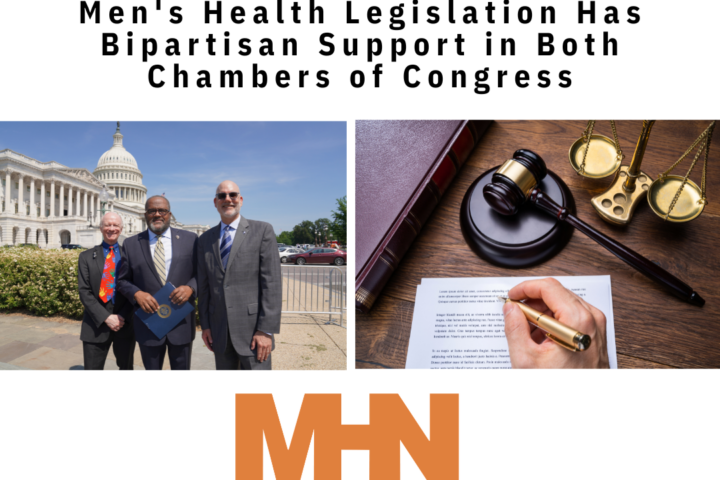
On July 22, the State of Men’s Health Act was introduced in the U.S. Senate by Senators Ruben Gallego (D-AZ) and Roger Marshall, M.D. (R-KY), creating a bipartisan Senate companion to the House bill introduced earlier this year by Representatives Troy A. Carter, Sr. (D-LA) and Greg Murphy, M.D. (R-NC).
This is the first time legislation to establish a federal Office of Men’s Health has been introduced in both the U.S. House of Representatives and the U.S. Senate during the same Congress, marking an unprecedented level of bipartisan and bicameral support for improving the health and well-being of men and boys.
The legislation would establish an Office of Men’s Health within the U.S. Department of Health and Human Services (HHS) while directing the U.S. Government Accountability Office (GAO) to conduct the first comprehensive assessment of men’s health in the United States. Together, these efforts would help strengthen federal coordination, improve public awareness, identify gaps in care, and support evidence-based recommendations to improve men’s health outcomes nationwide.
While the legislation still has several steps to complete before becoming law, introducing companion bills in both chambers of Congress is an important step forward. It reflects growing recognition among policymakers that men’s health deserves a coordinated national strategy and reinforces the broad, bipartisan support behind this effort.
Men’s Health Network (MHN) is grateful to the bill sponsors and to the many healthcare organizations, advocates, and supporters who have helped bring men’s health to the forefront of the national conversation. We look forward to continuing our work with Congress and our partners to advance the State of Men’s Health Act and improve the health and well-being of men, boys, and their families.
—
The National Conversation Around Men and Boys Continues to Grow
Perhaps one of the most encouraging developments over the past year has been the growing recognition that improving outcomes for men and boys benefits everyone.
Across the country, policymakers are exploring new ways to address issues affecting men and boys through commissions, advisory councils, executive actions, workforce initiatives, educational programs, and public health efforts.
Recent examples include:
- Virginia advancing legislation to establish a Boys and Men Advisory Commission.
- Washington State continuing efforts to establish a Boys & Men Commission.
- California launching initiatives supporting young men and boys.
- Maryland implementing targeted efforts focused on improving outcomes for men and boys.
- Michigan expands workforce and educational opportunities.
- Utah creating a task force focused on male well-being.
These developments represent an important shift.
For many years, conversations surrounding health disparities largely overlooked the unique challenges facing men and boys. Today, more policymakers are recognizing that improving men’s health, educational outcomes, workforce participation, and mental well-being strengthen families, communities, and society as a whole.
—
Why Coalition Advocacy Matters
One of the themes connecting each of these efforts is collaboration.
Whether advocating for clinical trial access, protecting patients from unsafe medications, increasing federal investment in medical research, restoring prostate cancer funding, or advancing men’s health policy, lasting progress rarely comes from a single organization acting alone.
Coalition advocacy allows organizations with different missions and areas of expertise to unite around common goals. Together, these partnerships amplify the voices of patients, healthcare providers, researchers, caregivers, and advocates while providing policymakers with broad, evidence-based perspectives on complex public health issues.
For MHN, these partnerships are an essential part of our mission.
We recognize that improving men’s health means engaging in conversations that extend well beyond traditional awareness campaigns. It means working alongside cancer organizations, medical societies, pharmacy advocates, military health experts, patient organizations, and public health leaders to support policies that improve prevention, access to care, research, and health outcomes.
Every coalition letter we sign, every partnership we build, and every policy discussion we join reflects our ongoing commitment to advancing the health and well-being of men, boys, and their families.
—
Looking Ahead
The work highlighted in this update reflects what makes public health advocacy successful: collaboration.
Whether supporting clinical trial access, strengthening patient safety, advancing medical research, restoring prostate cancer funding, or building support for the State of Men’s Health Act, lasting progress happens when organizations come together around a common goal.
Men’s Health Network (MHN) is proud to work alongside medical societies, patient advocacy organizations, researchers, policymakers, and community leaders to advance policies that improve the health and well-being of men, boys, and their families.
We thank our partners for their continued collaboration and look forward to sharing more updates as these important initiatives continue to move forward.