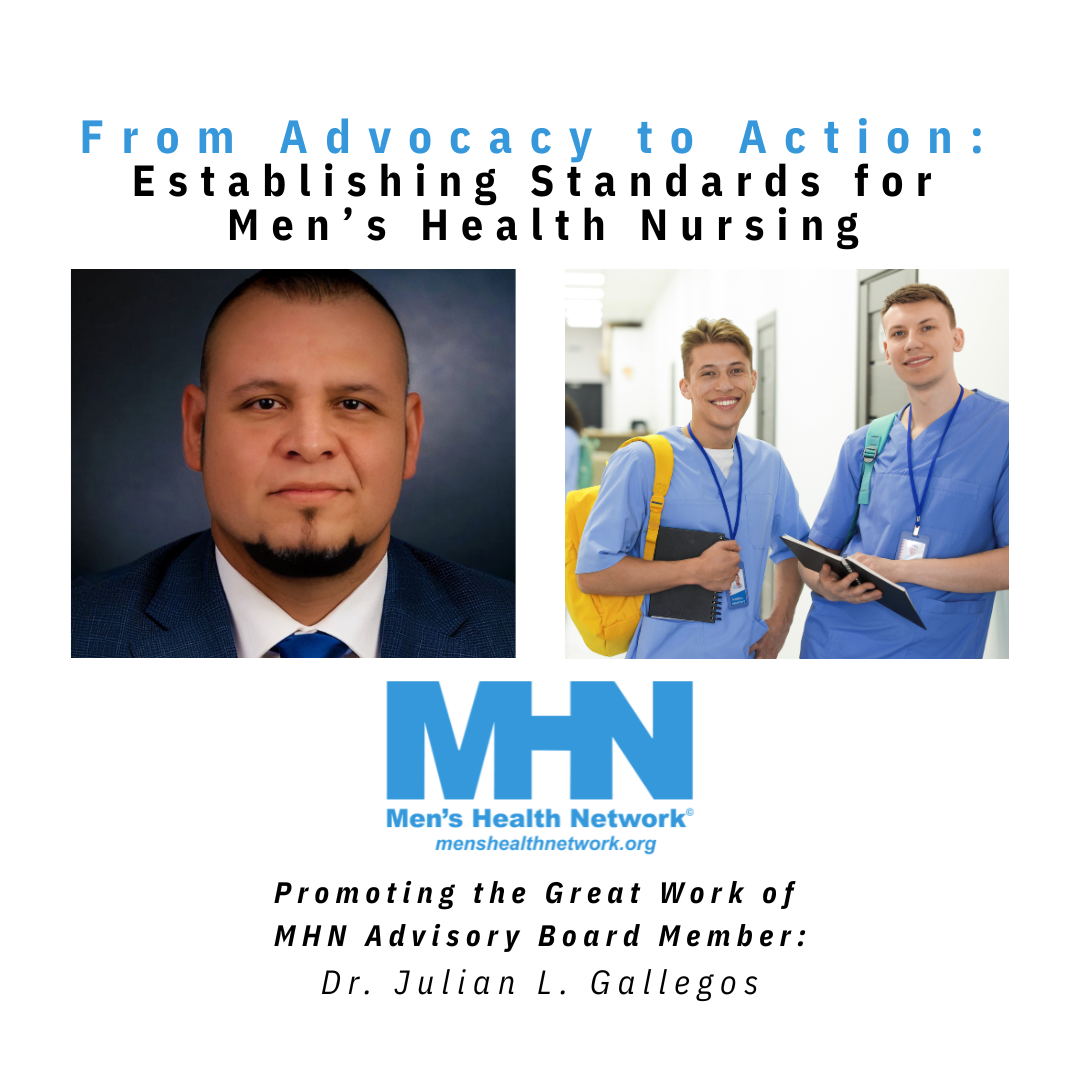
From Advocacy to Action:
Establishing Standards for Men’s Health Nursing
There are moments in a movement when years of quiet, steady work suddenly become visible. When what was once an idea becomes infrastructure. When advocacy becomes action.
This is one of those moments.
Men’s Health Nursing has now achieved formal specialty recognition through approval of its Scope and Standards of Practice by the American Nurses Association (ANA). For the first time, men’s health has been recognized within a health profession as a clearly defined specialty with its own national standards.
For those who have worked in men’s health for decades, this milestone represents far more than a professional designation. It marks a turning point in how our healthcare system understands, names, and responds to the health needs of boys and men.
And it moves the conversation from awareness to implementation.
Why This Matters
For years, Men’s Health Network has highlighted the persistent and preventable disparities affecting men in the United States:
- Men die nearly six years earlier than women on average.
- Men experience higher mortality in 9 of the top 10 causes of death.
- Men account for nearly 80 percent of suicides nationwide.
- Men are more likely to delay care, avoid preventive screenings, and enter the healthcare system only when conditions have progressed.
We often talk about the Lifespan Gender Gap. We talk about suicide. We talk about chronic disease. We talk about workplace injury and occupational risk.
But here is the deeper question:
Who is structurally responsible for addressing these patterns in day-to-day care?
Until now, men’s health has largely been treated as an informal interest area, scattered across primary care, urology, cardiology, mental health, and emergency services. Important work has been done, but without unified standards guiding how nurses are educated, trained, and evaluated in caring specifically for boys and men.
The recognition of Men’s Health Nursing as a specialty changes that.
Turning a Concept into Standards
This achievement did not happen overnight.
Julian Gallegos, a clinician, researcher, and advisory board member of Men’s Health Network, helped lead the effort to move Men’s Health Nursing from concept to formal recognition. Through the American Men’s Health Nursing Alliance, working in partnership with the American Association for Men in Nursing and a national team of nurse leaders, he helped convene experts to answer a foundational question:
What does Men’s Health Nursing actually require?
The result is the first-ever Scope and Standards of Practice for Men’s Health Nursing. This document defines:
- The role and responsibilities of a men’s health nurse
- The competencies required to practice effectively
- The ethical and professional expectations guiding care
- The standards by which performance and education can be evaluated
The document was formally reviewed through the ANA specialty recognition process and approved by the ANA Board of Directors.
This approval means that men’s health is no longer simply an area of concern. It is a defined field of nursing practice.
That distinction matters.
Empathy in Action
At Men’s Health Network, we often talk about closing the Empathy Gap in men’s health.
Men are often perceived as strong, self-reliant, or stoic. Too often, those perceptions become barriers to care. Symptoms are minimized. Emotional struggles are overlooked. Preventive care is postponed.
Empathy in men’s health means recognizing that behind statistics are fathers, sons, brothers, husbands, coworkers, and friends. It means understanding how cultural expectations, occupational identity, and life pressures shape health behaviors. It means creating healthcare environments where men feel seen, heard, and supported.
A recognized nursing specialty makes empathy operational.
When nurses are trained with clear standards for understanding delayed care, chronic stress, occupational risk, mental health vulnerability, and communication patterns unique to men, empathy becomes part of professional practice, not just personal instinct.
This specialty gives nurses tools to engage men earlier. To ask better questions. To screen more intentionally. To identify risk before it becomes crisis.
That is not abstract progress. That is life-saving work.
Bridging Advocacy and Front-Line Care
For decades, Men’s Health Network has worked to elevate awareness at the national level through education, policy advocacy, and outreach. We have championed Men’s Health Month, International Men’s Health Week, and initiatives focused on prostate cancer, testicular cancer, suicide prevention, and chronic disease prevention.
But advocacy alone is not enough.
Awareness must translate into action inside clinics, hospitals, schools, rural practices, occupational health programs, and community settings.
The formal recognition of Men’s Health Nursing builds that bridge.
It creates a clinical infrastructure capable of delivering on the vision that advocates have articulated for years. It aligns education, professional development, and patient care with the real-world challenges facing men today.
Nurses guided by these standards are better prepared to:
- Encourage preventive screenings
- Address mental health stigma
- Recognize occupational hazards
- Navigate chronic disease management
- Support fathers, caregivers, and partners
- Engage men in conversations about lifestyle, stress, and long-term wellness
This is how movements mature. Not just by raising awareness, but by embedding change into systems.
A Milestone for the Entire Field
To the best of current knowledge, this is the first time any health profession has formally recognized men’s health as a specialty with its own national scope and standards.
That statement alone signals the scale of this moment.
Men’s health is no longer peripheral. It is no longer assumed to be adequately covered under general practice. It is acknowledged as distinct, complex, and worthy of focused expertise.
And that recognition benefits everyone.
- When men receive timely preventive care, families are stronger.
- When men’s mental health is addressed early, communities are safer.
- When chronic disease is managed effectively, healthcare costs decrease.
- When fathers are healthy, children thrive.
Men’s health has always been family health.
Looking Ahead
This milestone is not the end of the journey. It is the beginning of a new chapter.
Specialty recognition lays the foundation for:
- Expanded educational programs
- Future certification pathways
- Research growth
- Policy alignment
- National collaboration across disciplines
It also reinforces a broader message: men’s health deserves structure, standards, and sustained attention.
Men’s Health Network remains committed to advancing a coordinated response to the persistent disparities facing boys and men. From policy efforts like the State of Men’s Health Act to grassroots outreach in communities, we believe progress happens when empathy, advocacy, and professional practice move together.
The recognition of Men’s Health Nursing as a specialty demonstrates exactly that alignment.
Celebrating a Historic Advancement
We proudly recognize the leadership that helped move this effort across the finish line. Transforming an idea into nationally approved standards requires persistence, collaboration, and vision.
But most importantly, we celebrate what this milestone represents:
- A healthcare system that is beginning to respond more intentionally to the unique needs of boys and men.
- A profession willing to define what excellence in men’s health care looks like.
- A future in which empathy is supported by structure.
This is a defining moment for men’s health.
And for the millions of men and families who depend on a healthcare system that sees them clearly, it is a step toward longer, healthier lives.