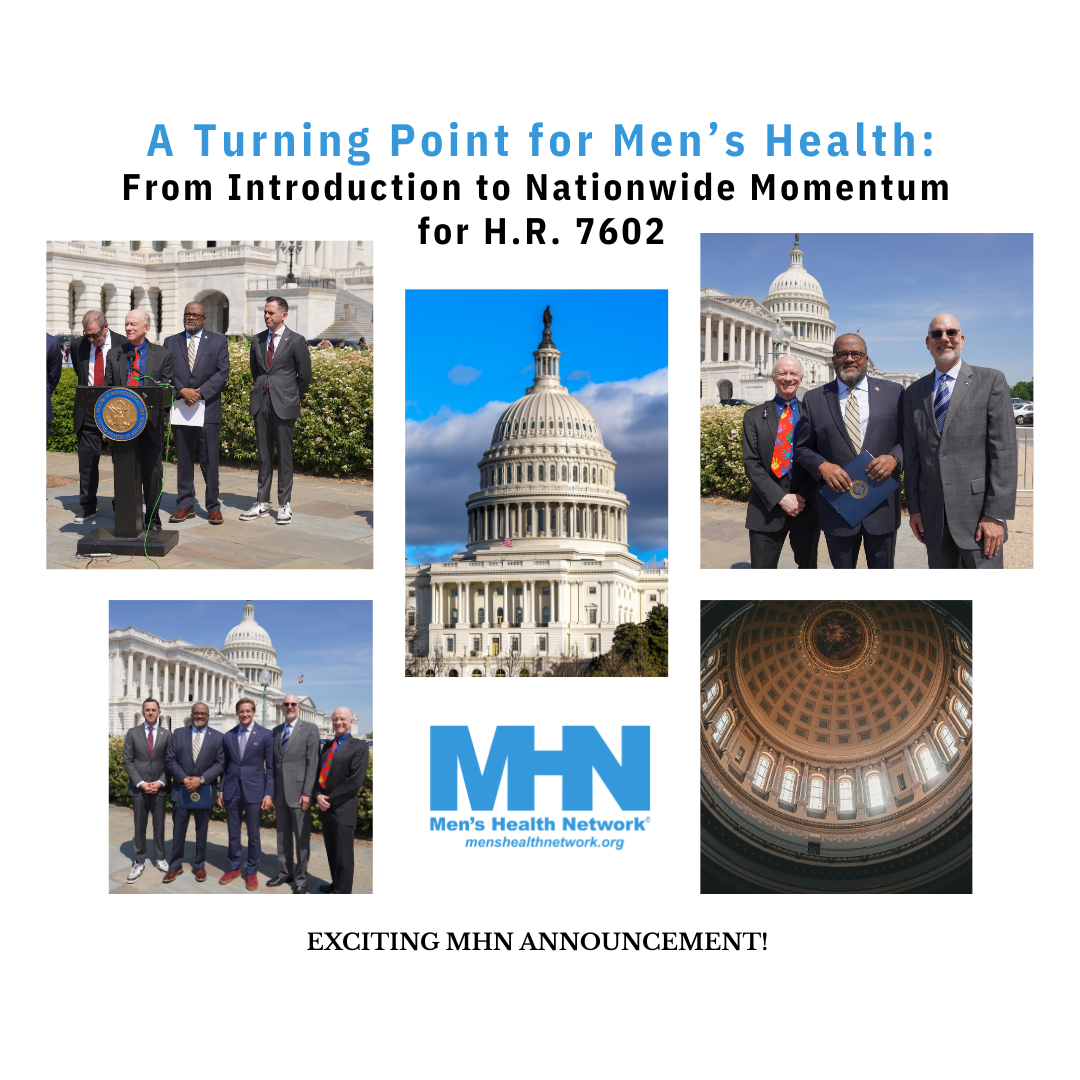
A Turning Point for Men’s Health:
From Introduction to Nationwide Momentum for H.R. 7602
On February 23, 2026, a historic milestone was reached in the men’s health movement.
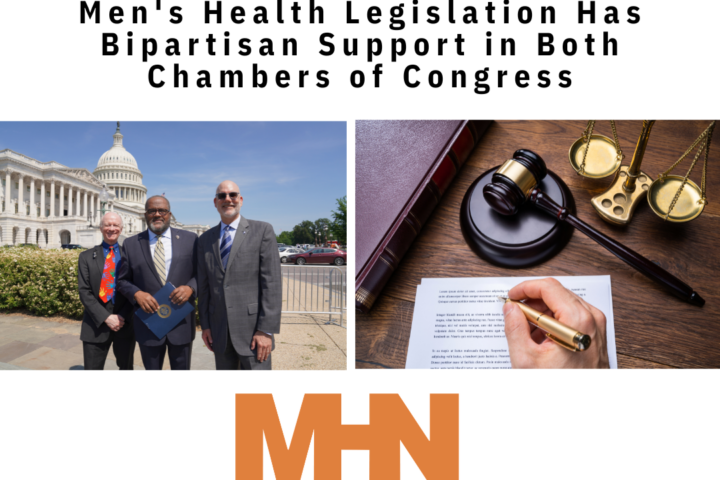
The introduction of the State of Men’s Health Act (H.R. 7602), led by Troy Carter with bipartisan support from members of the Congressional Men’s Health Caucus, marked the first serious federal step toward establishing an Office of Men’s Health within the U.S. Department of Health and Human Services (HHS). The full text of the bill can be found [HERE].
The following day, Men’s Health Network (MHN) issued its first official press release endorsing the legislation, declaring that the need for coordinated federal action had never been more urgent .
Today, only days later, the momentum has grown.
What began as a long-advocated goal is now becoming a coordinated national movement, supported by major medical organizations, strengthened by formal clinical recognition, and energized by bipartisan cooperation on Capitol Hill.
This is more than a bill introduction.
It is a structural shift.
Why H.R. 7602 Matters
The State of Men’s Health Act directs the Secretary of Health and Human Services to conduct a comprehensive study on the state of men’s health in the United States and to establish an Office of Men’s Health within HHS.
Importantly:
- The legislation authorizes no new funding.
- It does not divert resources from women’s health programs.
- It focuses on coordination, accountability, research, and prevention.
The urgency behind the bill is clear.
As outlined in MHN’s initial release:
- The Lifespan Gender Gap has widened to 5.9 years.
- Men experience higher mortality in 9 of the top 10 causes of death.
- Men die at an overall rate 1.4 times higher than women.
- Men account for nearly 80% of suicides nationwide.
These outcomes do not affect men alone. They affect wives, partners, children, workplaces, veterans’ communities, faith communities, and entire family systems.
“As the nation’s leading nonprofit dedicated to improving the health and well-being of men, boys, and their families, we proudly endorse the introduction of H.R. 7602,” MHN stated in its original announcement.
This bill is not about competition between health priorities. It is about closing gaps, strengthening coordination, and addressing preventable disparities that have persisted for decades.
From Introduction to Expanding Coalition
Since its introduction, H.R. 7602 has gained visible traction.
National organizations that have publicly expressed support include:
- American Urological Association
- American Medical Association
- ZERO Prostate Cancer
- Men’s Health Network
- Additional clinical and advocacy organizations nationwide
For many, this marks the first time they have publicly endorsed federal men’s health infrastructure.
That matters.
Men’s health has historically existed in a fragmented space, addressed through individual disease silos (prostate cancer, cardiovascular disease, mental health, workplace injury) rather than through a coordinated federal framework.
The alignment we are now witnessing signals that the field itself is maturing.
A Historic First: Men’s Health Nursing Recognized as a Specialty
At the same time that federal momentum builds, the clinical world has reached its own historic milestone.
The American Nurses Association has formally recognized Men’s Health Nursing as a specialty, the first time any health profession has formally recognized men’s health with its own national scope and standards.
This recognition was spearheaded by MHN Advisory Board Member Julian L. Gallegos, PhD, MBA, APRN, FNP-BC, and founder of the American Men’s Health Nursing Alliance, in partnership with the American Association for Men in Nursing.
As outlined in MHN’s formal announcement, Dr. Gallegos convened a national team of nurse experts to develop the first Scope and Standards of Practice for Men’s Health Nursing, a document vetted through the ANA specialty recognition process and approved by its Board of Directors.
To the best of current knowledge, this is the first time any health profession has recognized men’s health as a formal specialty with defined competencies and national standards.
For MHN, this milestone represents more than symbolic progress.
It represents infrastructure.
- Advocacy creates awareness.
- Policy creates coordination.
- Clinical standards create implementation.
When legislation, medical endorsements, and professional standards move forward together, the field stabilizes.
Advocacy Meets Infrastructure
The introduction of H.R. 7602 reflects that sustained work.
- National endorsements reflect growing alignment.
- The nursing specialty recognition reflects clinical maturity.
- Together, they signal something deeper:
- Men’s health is no longer a loosely defined advocacy issue.
It is now:
- The subject of formal congressional legislation.
- Supported by major national medical organizations.
- Recognized as a standards-driven clinical specialty.
- Strengthened by bipartisan cooperation.
As Ronald Henry, MHN President, stated:
“Too many men are dying too young from preventable or treatable conditions. An Office of Men’s Health is essential not only for the men themselves, but also for the wives, sisters, and daughters who love them.”
- That framing is critical.
- Men’s health is family health.
- Men’s health is workforce health.
- Men’s health is community health.
Why This Moment Feels Different
There have been conversations about men’s health for years.
What feels different now is convergence.
- Data is clear.
- Disparities are documented.
- Clinical standards now exist.
- Major organizations are speaking publicly.
- Bipartisan leadership is engaged.
- Infrastructure can now support policy action.
And the legislation itself is fiscally responsible.
H.R. 7602 authorizes no new funding and does not divert resources from women’s health programs. It focuses on coordination, the kind that strengthens prevention, screening, research, and education efforts across agencies.
In other words, it builds smarter systems.
A National Call to Action
Men’s Health Network encourages:
- Healthcare professionals
- Veterans’ organizations
- Employers
- Faith and community leaders
- Families
- Researchers
- Educators
…to contact their Members of Congress in support of H.R. 7602.
Establishing an Office of Men’s Health would:
- Strengthen federal coordination.
- Enhance research focus.
- Support prevention-centered strategies.
- Close the Lifespan Gender Gap.
- Improve longevity and quality of life.
- Strengthen families and communities.
This is not about elevating one group at the expense of another.
It is about closing measurable gaps that affect millions of families across the country.
The Road Ahead
The introduction of H.R. 7602 was the spark.
The growing national coalition is the fuel.
The formal recognition of Men’s Health Nursing is the structural foundation.
Together, they represent a turning point.
Men’s Health Network was founded in 1992 with a simple but powerful mission: to reach men, boys, and their families where they live, work, play, and pray.
For decades, that work has involved research, education, outreach, policy advocacy, and coalition-building.
Now, for the first time, those efforts are aligning at the federal, clinical, and organizational levels simultaneously.
The conversation has evolved.
- The coalition is expanding.
- The infrastructure is strengthening.
- And the momentum is real.
- This is what structural change looks like.
- This is what coordination looks like.