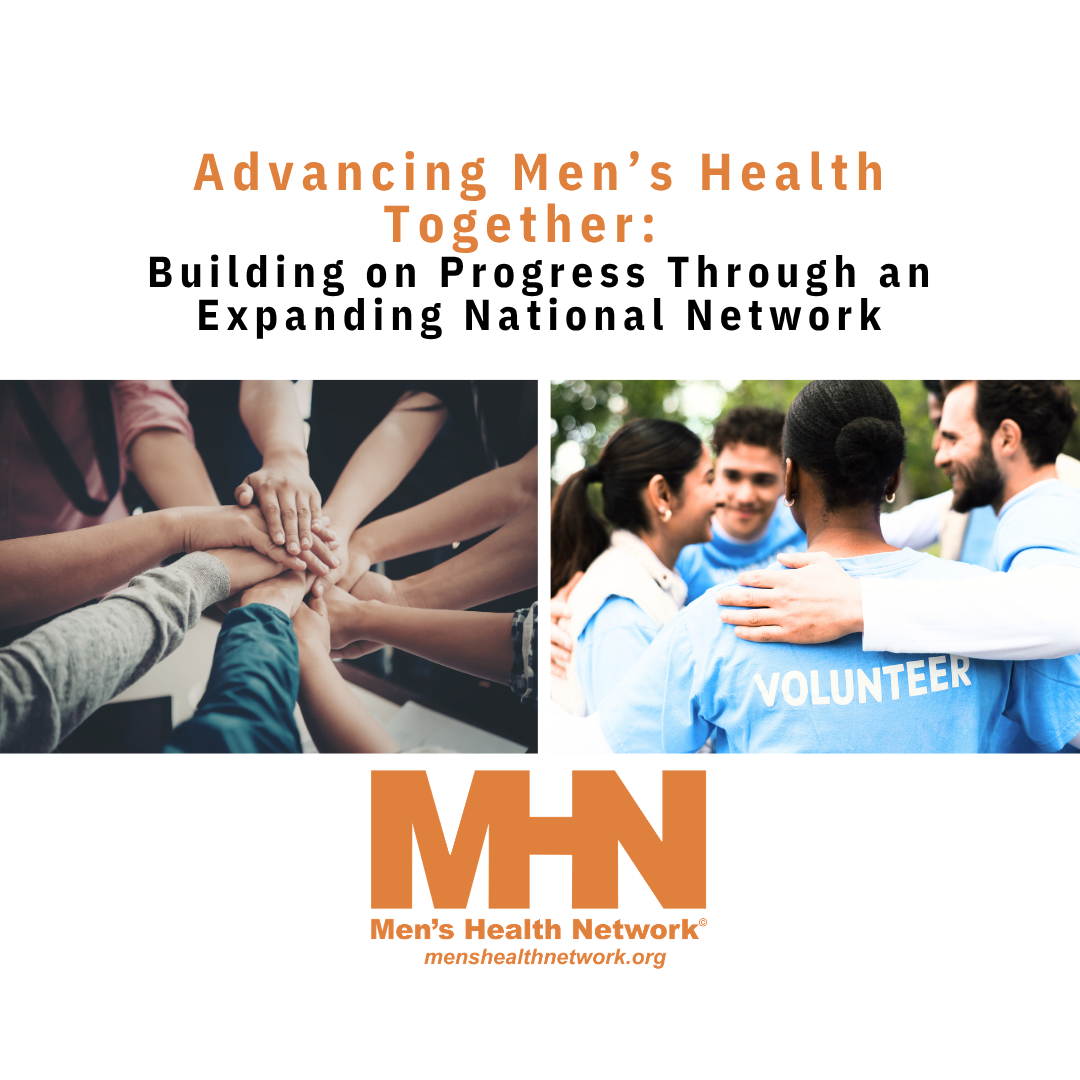
Advancing Men’s Health Together:
Building on Progress Through an Expanding National Network
At Men’s Health Network (MHN), we have always believed that real progress in men’s health is not defined by a single program, campaign, or organization. It is defined by movement—by sustained, measurable advances that improve the lives of men, boys, and their families.
Today, that movement is accelerating.
Across the country, we are seeing legislative wins, increased media attention, new state-level initiatives, and stronger coordination among partners. These are not isolated developments. They are connected milestones that reflect the growth and strength of an expanding national network.
Now is the time to recognize that progress more intentionally—and to document it.
From Individual Wins to a National Timeline
One of the most important opportunities in front of us is the ability to build and maintain a clear, visible timeline of “Advances in Men’s Health.”
Not just as a record of activity, but as a strategic asset.
A living timeline allows MHN to:
- Demonstrate sustained leadership in the men’s health movement
- Highlight measurable progress across policy, awareness, and care
- Reinforce credibility with partners, policymakers, and stakeholders
- Show how individual efforts connect into a broader national impact
This is especially important as the pace of progress increases.
We are no longer in a phase where men’s health advancements are occasional. They are becoming consistent, multi-state, and multi-sector.
A Real-Time Example: Policy Momentum in Prostate Cancer Screening
The recent progress around no-cost prostate cancer screening is a perfect example of how this timeline is being built in real time.
In Maine, LD 1502—legislation to provide no-cost PSA screening—has reached the Governor’s desk. This represents a critical step toward removing financial barriers to early detection.
At the same time:
- Alabama has passed SB 19, becoming the 10th state to eliminate cost barriers for high-risk men
- Active campaigns are underway in New Jersey, Ohio, Pennsylvania, Georgia, and Arizona
- Additional legislation is being developed in Louisiana and Mississippi
These are not disconnected updates. They are part of a coordinated national strategy led by partners like ZERO Prostate Cancer and supported by a broad coalition that includes MHN and leading organizations such as the American Urological Association and the National Comprehensive Cancer Network.
Each legislative step—introduction, committee movement, passage, implementation—is a milestone.
Each milestone belongs on the timeline.
Why This Matters for MHN’s Leadership
MHN’s strength has always been our ability to convene, connect, and amplify.
We are not just participants in these efforts. We are part of the infrastructure that allows them to succeed.
By building a timeline of advances, MHN can clearly demonstrate:
- Our role in supporting and expanding national coalitions
- Our connection to policy wins across multiple states
- Our contribution to awareness campaigns that drive action
- Our ability to translate network activity into measurable outcomes
This is how we reinforce our position as a national leader in men’s health.
Not by claiming sole ownership of progress—but by showing how we strengthen and scale it.
What Belongs on the “Advances in Men’s Health” Timeline
To be effective, this timeline should be structured, consistent, and easy to maintain.
Key categories of milestones could include:
Policy & Legislative Wins
- State-level laws removing cost barriers to screening
- Creation of state men’s health commissions or task forces
- Federal developments, including progress on national legislation
Clinical & Public Health Advancements
- Adoption of new screening guidelines
- Expansion of preventive care access
- Data demonstrating improved outcomes (e.g., increased screening rates)
Network & Partnership Growth
- New coalition partnerships
- Expansion of multi-state campaigns
- Cross-sector collaborations (healthcare, policy, community)
Media & Cultural Visibility
- Major media coverage highlighting men’s health issues
- Podcast and digital media growth (e.g., MHN’s own initiatives)
- Increased public conversation around men’s health topics
MHN Organizational Milestones
- Launch of new programs or toolkits
- Expansion of the Ambassador Program
- Growth in national reach and engagement
Each entry should answer a simple question: What changed—and why does it matter for men’s health?
The Power of Aggregation
Individually, each of these milestones is important.
Collectively, they tell a much bigger story.
They show:
- A movement gaining traction
- A network becoming more coordinated
- A policy environment becoming more responsive
- A cultural shift toward recognizing men’s health as a priority
For stakeholders—whether policymakers, funders, or partners—this aggregated view is powerful.
It transforms scattered updates into a clear narrative of progress.
Making It Sustainable
For this to work long-term, the timeline must be easy to update and maintain.
A few practical considerations:
- Use a standardized format for entries (date, milestone, impact, MHN role)
- Assign ownership for updates (e.g., communications or policy tracking)
- Integrate updates into existing workflows (weekly reports, partner calls, press tracking)
- Leverage partner updates (such as those from ZERO Prostate Cancer) to capture developments efficiently
This should not feel like a separate project. It should be an extension of what MHN is already doing—just organized and visible.
A Strategic Asset for the Future
Over time, this timeline becomes more than a webpage.
It becomes:
- A credibility tool for grant proposals and partnerships
- A resource for media and public education
- A reference point for policymakers
- A reflection of MHN’s long-term impact
It also aligns directly with how MHN already positions itself—as a national convener with a broad, influential network.
The difference is that now, that impact is clearly documented and easily communicated.
Building the Narrative of Progress
The men’s health movement is entering a new phase.
We are seeing:
- More legislative wins
- More coordinated advocacy
- More data-driven decision making
- More public attention
But what makes this moment different is not just the volume of activity—it is the alignment behind it.
Across the country, efforts that once operated independently are now connected. Policy campaigns are informed by real-world data. Advocacy organizations are sharing strategies across state lines. Clinical leaders are aligning around evidence-based guidelines. Media coverage is no longer sporadic—it is becoming sustained and issue-driven.
This is what progress looks like when a movement matures.
We are seeing it in real time through efforts like no-cost prostate cancer screening legislation. From Alabama to Maine, and across states like New Jersey, Ohio, and Pennsylvania, policy is no longer isolated—it is iterative. Each state builds on the last. Each win informs the next.
At the same time, organizations like ZERO Prostate Cancer are leveraging claims data to demonstrate increased screening rates following policy implementation. That data is then used to strengthen legislative arguments, improve messaging, and accelerate adoption in additional states.
This is not just advocacy. It is a feedback loop of progress.
And yet, despite this momentum, much of this work remains fragmented in how it is communicated.
The question is no longer whether progress is happening.
The question is how well we are capturing and communicating it.
Right now, milestones live in emails, policy updates, partner calls, press releases, and internal documents. They are real. They are meaningful. But they are not always visible in a way that tells a cohesive story.
That is the opportunity.
By building and maintaining a timeline of “Advances in Men’s Health,” Men’s Health Network can transform individual updates into a clear, structured narrative of progress.
A timeline does more than document activity. It:
- Connects local wins to national impact
- Demonstrates sustained momentum over time
- Reinforces credibility with policymakers, partners, and funders
- Shows how data, advocacy, and awareness translate into real-world outcomes
It also allows MHN to contextualize its role—not as a single actor, but as a central connector within a growing ecosystem.
Over time, this becomes a powerful tool.
Not just for reporting what has happened—but for showing where the movement is going.
The Network Is the Story
At its core, this is not just about tracking milestones.
It is about showing how those milestones are achieved.
Because progress in men’s health does not happen in isolation. It happens through connection.
Through partnership.
Through coordination.
Through an expanding national network.
Every legislative win reflects collaboration between advocates, clinicians, policymakers, and community leaders. Every increase in screening rates reflects alignment between policy and practice. Every surge in public awareness reflects coordinated messaging across organizations and platforms.
The network is not supporting the work.
The network is the work.
This is where Men’s Health Network stands apart.
MHN does not operate as a single-issue organization or a siloed initiative. It operates as a national convener—bringing together stakeholders across sectors, aligning efforts, and ensuring that progress in one area strengthens progress in another.
When ZERO Prostate Cancer advances state-level legislation, MHN helps expand visibility and connect that effort to a broader audience. When clinical leaders like the American Urological Association and the National Comprehensive Cancer Network provide evidence-based guidance, that information is reinforced through advocacy, education, and communications across the network.
This is how scale is achieved.
Not by centralizing control—but by strengthening connections.
A well-built timeline makes this visible.
It shows not just what happened, but how it happened:
- Which partners were involved
- How data informed decisions
- How advocacy translated into policy
- How awareness translated into action
It tells the story behind the outcome.
And that story matters.
Because in today’s landscape, credibility is built not only on results, but on the ability to demonstrate how those results were achieved—and how they can be replicated.
That is MHN’s value.
To connect.
To amplify.
To align.
To scale.
And now, to clearly document and communicate that impact.
That is the story we have the opportunity to tell—clearly, consistently, and at scale.
And as the movement continues to grow, that story will only become more powerful.