Rethinking Masculinity:
Insights from The Masculine Self (7th Edition)
At Men’s Health Network (MHN), we know that improving men’s health goes beyond medical checkups and screenings. It also means taking a deeper look at the social and cultural forces that shape how men think about themselves and their health.
Masculinity, in all its complexity, influences whether men seek care, how they handle stress, and even how long they live.
That’s why we are spotlighting The Masculine Self (7th Edition), a landmark text by Andrew P. Smiler, PhD, and Christopher Kilmartin, PhD. This edition provides fresh insights into how masculinity is experienced today and what that means for men’s well-being.
📘 You can purchase a copy of the textbook here: The Masculine Self (7th Edition) on Amazon.
We are especially proud to highlight this work because Dr. Andrew P. Smiler is an Advisory Board Member of Men’s Health Network. His expertise has long helped advance conversations about men’s health in ways that are practical, compassionate, and deeply needed.
Masculinity as a Social Force
The book reminds us that masculinity is not a single fixed identity. It is shaped through families, schools, peers, and media, and those influences often guide how men see themselves and make decisions. As Smiler and Kilmartin note in Chapter 11, “masculine norms influence how men perceive themselves, their relationships, and their willingness to seek help” (Smiler & Kilmartin, 2024, p. 311).
This has direct consequences for health. For example, cultural messages that men should be “tough” or avoid showing vulnerability can discourage them from seeking medical care or mental health support. These patterns don’t reflect weakness; they reflect the pressures many men experience as they grow up.
At MHN, we work to ease these pressures by normalizing preventive health care, encouraging emotional openness, and creating supportive spaces for men and boys.
Violence, Health, and Masculinity
One of the most thought-provoking sections of the text examines how violence and masculinity intersect. The research shows that while men are more often involved in acts of violence, they are also more frequently the victims of it. As Smiler and Kilmartin explain, “homicide is primarily a form of male-on-male violence” (Smiler & Kilmartin, 2024, p. 328).
Rather than framing this as an issue of blame, it’s important to recognize how cultural expectations can sometimes place men at higher risk. Understanding these patterns allows us to focus on prevention, support, and healthier pathways for boys and men as they grow.
Suicide and Emotional Stoicism
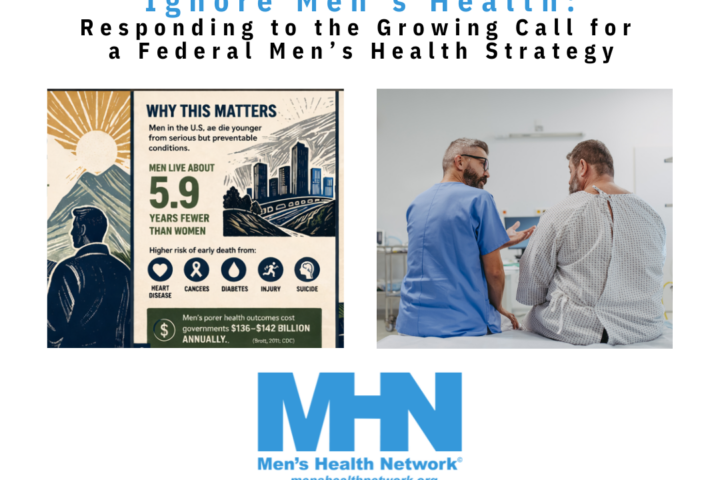
The book also sheds light on suicide, an area where men face disproportionate risk. Men account for nearly 80% of suicide deaths in the United States, with older men in particular dying by suicide at higher rates than women.
Smiler and Kilmartin connect this to the way men are often socialized:
“Masculine norms contribute to the suicide rate due to their emphasis on emotional stoicism, not confiding in friends, the importance of solving problems on one’s own, and the emphasis on ‘getting the job done.’” (Smiler & Kilmartin, 2024, p. 366)
This perspective reinforces what we see at MHN, that men’s reluctance to seek help is not about unwillingness, but about the cultural messages they receive.
By fostering empathy and normalizing conversations about mental health, we can offer men healthier alternatives and potentially lifesaving support.
The Role of Media and Peers
Smiler and Kilmartin also explore how friends and media influence men’s understanding of masculinity. Boys who grow up in environments where aggression is normalized, through peer groups, sports, or screen media, may come to see it as expected.
The authors note that “as the amount of media-based violence an individual consumes increases, so too does their support for real-life violent behavior, including intimate partner violence” (Smiler & Kilmartin, 2024, p. 447).
This doesn’t mean all boys who play video games or watch movies will become violent.
Rather, it highlights the importance of teaching media literacy, encouraging empathy, and building friendships based on respect. When we help boys and young men develop these skills, we give them healthier models of masculinity to carry forward.
Health Beyond the Doctor’s Office
The Masculine Self also shows how beliefs about masculinity can affect men’s physical health. Men who strongly endorse rigid ideas of what it means to “be a man” tend to have worse health outcomes and shorter life expectancies.
Research cited in the book demonstrates that “the increase in mortality risk in masculine individuals…was comparable to increases in mortality risk associated with elevated blood pressure” (Lippa et al., 2000, as cited in Smiler & Kilmartin, 2024, p. 502).
In other words, holding on to narrow definitions of masculinity can carry risks for men’s health just as much as other well-known medical factors. This underscores the importance of helping men feel supported in broadening their understanding of masculinity, making room for self-care and healthier life choices.
Moving Forward: Building Healthier Masculinity
The authors close with an encouraging message: masculinity can evolve, and with it, so can men’s health outcomes.
They remind us that:
“Greater connection to others decreases an individual’s willingness to commit violent acts against others or oneself, and the loss of such connections can serve as a trigger for these forms of violence.” (Smiler & Kilmartin, 2024, p. 420)
At MHN, we see this as an invitation to focus on connection, empathy, and community.
Men benefit when they feel supported, when they have spaces to share honestly, and when their health is treated as a shared priority.
Why This Book Matters Now
As public conversations about masculinity continue, The Masculine Self (7th Edition) offers both a roadmap and a reminder. It shows us that masculinity is complex, not something to criticize, but something to understand.
For MHN, the book reinforces our mission: to meet men and boys where they live, work, play, and pray, and to give them tools to live healthier, fuller lives.
We encourage students, professionals, and community leaders to engage with this important resource.
It’s not just an academic text; it’s a guide that helps us better understand men’s experiences and the challenges they face.
Learn More
-
📘 Purchase The Masculine Self (7th Edition): Amazon link
-
👤 Learn about Dr. Andrew P. Smiler, MHN Advisory Board Member
-
💙 Support MHN’s ongoing initiatives: menshealthnetwork.org
Citation:
Smiler, A. P., & Kilmartin, C. (2024). The masculine self (7th ed.). Sloan Publishing. https://sloanpublishing.com/smiler