
Foreword from Men’s Health Network
At a time when conversations about men’s roles in society are often polarized or oversimplified, Dr. David P. Jachim’s Men at the Brink: Masculinity in the 21st Century offers a deeply needed, balanced reflection. His work challenges us to reconsider what it means to be a man in today’s world, not through accusation or nostalgia, but through empathy, introspection, and courage.
As Dr. Jachim observes, masculinity has been increasingly viewed through a distorted lens, where terms like “patriarchy” and “toxic masculinity” are used as blanket condemnations rather than opportunities for understanding. This narrative leaves many men feeling alienated, devalued, or even ashamed of their identity, a reality that carries profound implications for mental health, relationships, and community well-being.
At Men’s Health Network, we believe that improving men’s health begins with improving how we see and speak about men. True progress requires empathy, not blame. It means recognizing that positive masculinity, grounded in integrity, responsibility, compassion, and courage, is essential to healthy families and communities. As Dr. Jachim writes, men have a responsibility to uphold these values, not by rejecting their identity, but by integrating strength with vulnerability and action with reflection.
Dr. Jachim’s insights serve as both a warning and a call for renewal. Masculinity is not the problem; the problem lies in misunderstanding it. Through awareness, self-care, and brotherhood, men can redefine strength in ways that heal rather than harm, connect rather than divide.
We are proud to feature the work of Dr. David Jachim, an esteemed member of the Men’s Health Network Advisory Board, whose lifelong dedication to men’s mental and emotional health exemplifies the kind of leadership and vision needed to restore balance and empathy in today’s conversations about masculinity.
— Men’s Health Network
Subscribe to our newsletter | Donate | Become an Ambassador | Text START to 202.998.5977
The Opinions within this blog do not necessarily reflect the opinions or stances of Men’s Health Network.
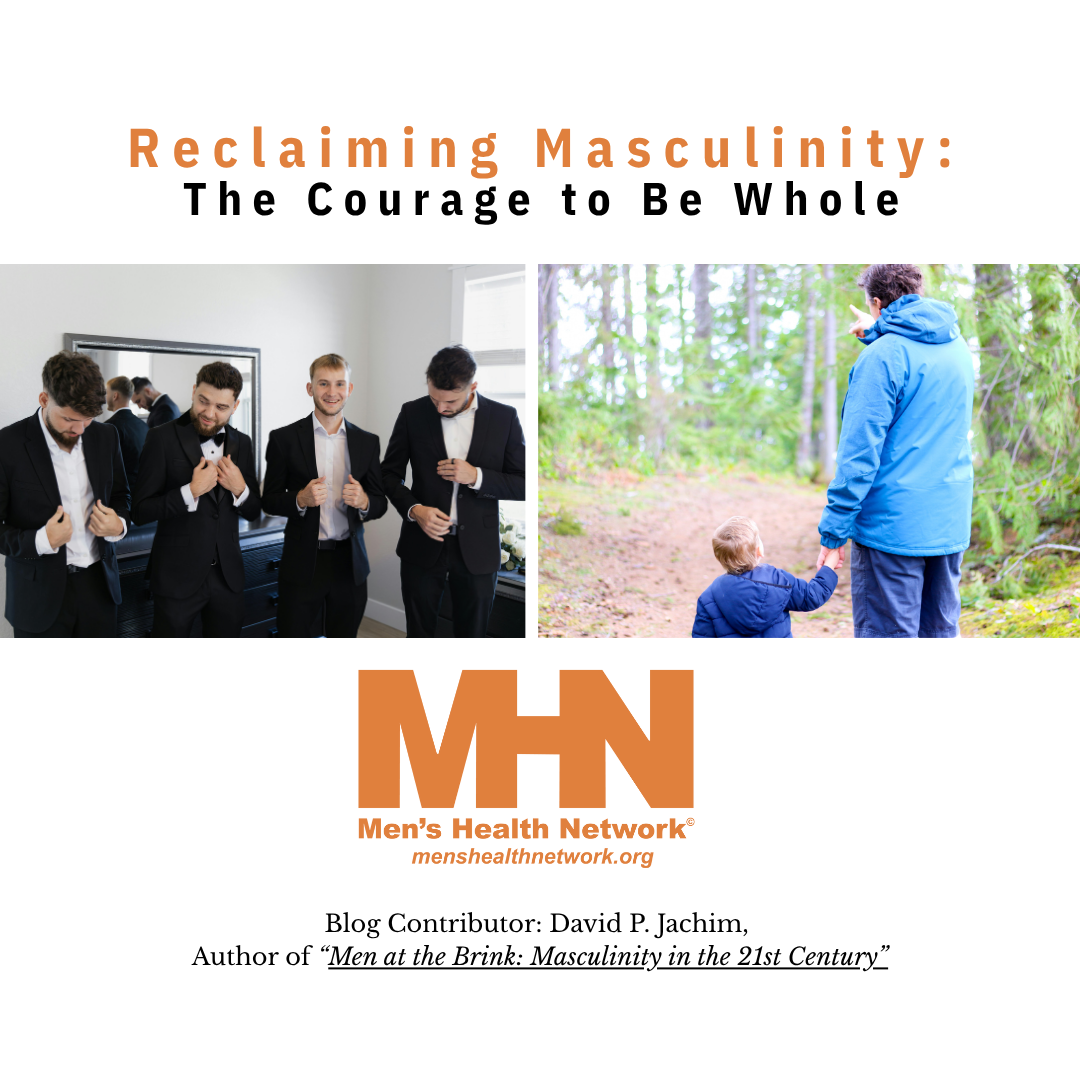
Reclaiming Masculinity:
The Courage to Be Whole
Excerpts from the book, “Men at the Brink: Masculinity in the 21st Century,” by David P. Jachim: The author explores the early roots of the masculine character, the skewed view of masculinity in mental health research, as well as the impact of present-day male taglines such as “patriarchy” and “toxic Masculinity.”
It is a warning about the fate of men and suggests ways to avert the terrible outcome of men falling from the brink.
Masculinity Today
You can feel men shrinking up.
— Anonymous
How do we go about defining masculinity? Unfortunately, in these turbulent times, masculinity is often seen in our society in a negative light, colored with complaints that range from its perceived roots in onerous “patriarchy” to what has become termed as a “toxic” gender identification. While some have attempted to write about the redeeming aspects of masculinity, the term, for many mental health and social critics, has become equated with an inborn aspect of evil in gendered men. Boys especially bear the brunt of this social narrative. They are often treated as if something was wrong with them for being male, and that somehow they need to be trained out of it. By extension, many men feel devalued, marginalized, confused, shamed, and angry. This is a sad predicament for both men and women, for it prevents true gender equality and endangers what both sexes really want: a two-way relationship that offers parallel love, respect, and vitality.
Subjective spins, such as the skewed versions of the patriarchy, have left many men feeling they are targets, responsible for all sorts of gender inequalities. This blaming scenario has led many men to retreat in silent rage. Some act out this rage through pornographic binging, substance abuse, suicide, and some, in extreme cases, by committing acts of violence
The Responsibility of Men
No one is coming to save you.
—Beaton
The primary responsibility for upholding the positive aspects of masculinity are men themselves. It is up to each individual man to resist the current ethos that calls into question the rue, positive aspects of masculinity such as thoughtful, decisive assertion, bravery and protectiveness. Affirmations of such qualities must also be integrated with qualities such as compassion, relatedness and vulnerability. This marriage of potentials is an act of courage and emotional grit, not cowardice. So, just as the Army recruiting ads promote, “Be All That You Can Be,” each man can accept all parts of himself to make a whole person.
An important first step towards this process is in self-care. This includes maintaining responsibility for one’s own mental, emotional and spiritual well-being. To deny these needs is not a signpost of strength but of weakness that leads to emotional catastrophe and a shortened lifespan. Seeking medical, mental and spiritual support is a sane, mature approach towards solving one’s own sense of a true, integrated masculinity. Deepening relationships with other men is also critical in one’s journey to revive positive masculinity and brotherhood. Every good man has the responsibility to listen to another good man. One might aspire to Hector, a main character Iliad story: a well-rounded man, ready to assess before acting and maintaining compassion for himself and towards others.
Masculinity is at a tipping point. The sociopolitical and ideological pressures to curtail manhood is driving them like lemmings to the proverbial cliff. By doing the work of self-integration the modern man can absorb this impact and rise as the mythological Phoenix, strong but flexible, determined but humble, decisive but emotionally open, assertive but loving.
Purchase Your Copy of “Men at the Brink: Masculinity in the 21st Century,” Today on Amazon.
About the Author:
David Jachim, PhD, FIPA Dr. David Jachim currently serves as an Advisory Board member at Men’s Health Network, and is an IPA certified psychoanalyst. Additionally, he is a board-certified psychoanalyst (CIPS), licensed clinical psychologist in the State of Washington, member of the International Psychoanalytical Association, and member of the American Psychological Association. Currently, he is a full faculty member of the Northwestern Psychoanalytic Society and Institute, and was the past President of the Northwestern Psychoanalytic Society and Institute.