
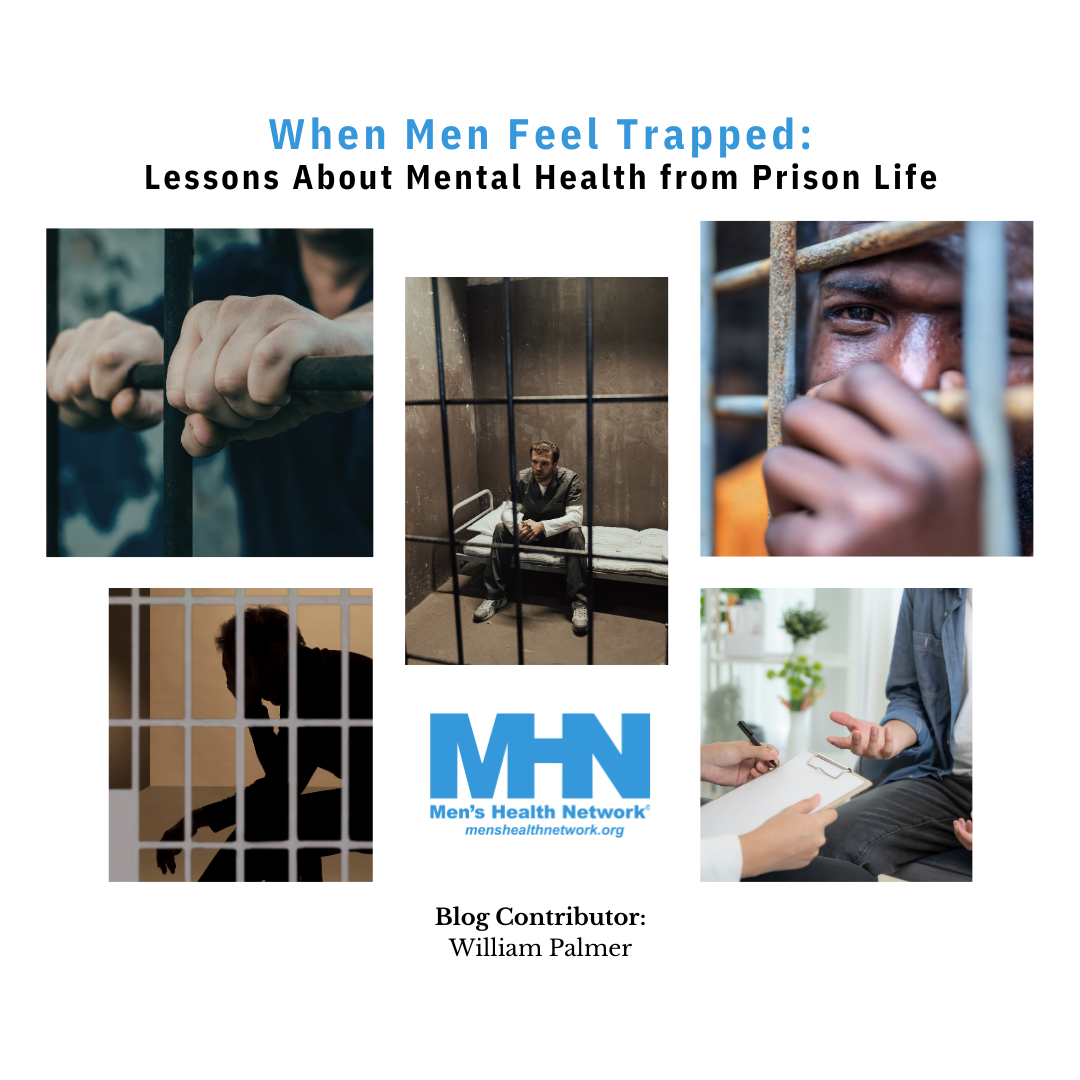
When Men Feel Trapped:
Lessons About Mental Health from Prison Life
By William Palmer
* The thoughts, opinions, and viewpoints of this blog do not necessarily reflect the viewpoint or stances of Men’s Health Network.
Most people assume prison is a psychological outlier—a place so extreme it has little to teach us about ordinary life. Razor wire, gun towers, lockdowns, numbers instead of names…
Surely that kind of pressure doesn’t resemble what men experience on the outside?
But after years of in depth discussion with former inmates from America’s darkest prisons and decades of learning from my father’s experience as a prison Chaplain in Los Angeles, I’ve come to believe the opposite.
Prison is not an exception. It’s a microcosm of the mental and spiritual battles men face everyday in modern society.
Strip life down to its essentials—control, time, identity, relationships—and you see with brutal clarity what breaks men psychologically and what helps them heal. What surprised me most wasn’t how different incarcerated men were from the rest of us. It was how familiar their inner lives felt to my own.
Different uniforms. Same pressures.
Pressure Reveals the Pattern
In prison, men live under constant surveillance. Their schedules are dictated. Their choices are limited. Their past mistakes are never allowed to fade into the background. Every day, they are reminded—explicitly and implicitly—who they are supposed to be.
That kind of pressure doesn’t create new psychological problems. It amplifies existing ones.
Men don’t unravel in prison primarily because of violence. They unravel because of:
- Loss of agency
- Chronic isolation
- Dehumanized & reductionist Identity
- Constant low-grade stress
- Emotional numbness disguised as toughness
Those same forces are quietly at work in modern life.
Most men I talk to outside prison don’t feel “oppressed” in any obvious sense. They have jobs, families, phones, “freedoms”. But listen long enough and you hear the same themes:
“I feel trapped.”
“I’m exhausted all the time.”
“I don’t know who I am outside of what I do.”
“I can’t slow down without feeling anxious.”
“I don’t really talk to anyone about how I truly feel.”
Prison makes the pattern visible. Modern life hides it behind productivity, entertainment, and respectability.
The Myth of Functioning
One of the most dangerous lies men absorb is this: If I’m functioning, I’m fine.
In prison, that illusion doesn’t last long. You can’t hide emotional collapse behind a busy schedule when your schedule is enforced. You can’t numb yourself indefinitely when your coping mechanisms are limited. Eventually, what you’ve been avoiding catches up with you.
Outside prison, men have far more ways to stay “functional” while quietly deteriorating:
- Overwork
- Alcohol or substances
- Endless scrolling
- Pornography
- Rage disguised as certainty
- Humor that never gets serious
Functioning is not the same as healthy.
I’ve seen men in prison who were emotionally healthier than men with corner offices and six-figure salaries—because they were forced to confront reality instead of outrunning it.
Pressure doesn’t destroy men. Avoidance does.
Identity: The First Casualty
In prison, the system assigns you an identity quickly. You become a number, a charge, a file. If you’re not careful, you start to cooperate with that story.
Outside prison, identity erosion is more subtle—but no less real.
Men are constantly reduced to roles:
- Provider
- Performer
- Problem-solver
- Protector
- Screw-up
- Liability
When a man begins to believe he is only his worst moment, his job title, his productivity, or his failures, his mental health starts to collapse from the inside out.
Depression often follows identity loss. So does anger.
Men aren’t just angry because they’re aggressive by nature. They’re angry because something essential has been taken from them, and they don’t know how to name the loss.
In prison, the men who stabilized psychologically were not the ones who denied their past or pretended to be tough. They were the ones who were helped to recover a sense of personhood—who they were beyond their crime, beyond their label, beyond their shame.
Men outside prison need the same recovery–a genuine revival of their human soul.
Isolation Is the Real Lockdown
Solitary confinement is widely recognized as psychologically damaging. Extended isolation destabilizes even the strongest minds.
What we don’t talk about enough is how many men live in a form of social solitary confinement while appearing socially connected.
They have coworkers but no confidants.
They have friends but no one who knows their interior life.
They have families but no safe space to speak honestly about fear, failure, or doubt.
In prison, isolation is enforced.
Outside prison, it’s self-maintained, often unintentionally.
Men are taught early that emotional disclosure is risky. That asking for help signals weakness. That carrying the weight quietly is honorable.
The result? Rising rates of depression, anxiety, addiction, and suicide.
What healed men most reliably in prison wasn’t information. It was presence—being listened to without being fixed, judged, or rushed. Brotherhood didn’t eliminate pain, but it made pain survivable.
The same is true outside.
Control Without Dignity Breaks People
One of the most instructive things I observed in prison was how men responded to authority.
Strict control without dignity produced resentment, withdrawal, or rebellion. Structure paired with respect produced stability.
Men need structure. We need rhythm, expectation, and responsibility.
But when structure becomes purely punitive or purely transactional—perform or else—mental health deteriorates quickly.
Modern men live under constant performance evaluation:
- Metrics
- Deadlines
- Rankings
- Algorithms
- Public comparison
When your worth feels conditional, your nervous system never rests.
In prison, the men who fared best psychologically were those entrusted with meaningful responsibility—mentoring others, serving in the chapel, maintaining order, contributing to something larger than themselves.
Responsibility restores dignity when it’s paired with trust.
Men outside prison aren’t starving for motivation. They’re starving for purpose.
The Quiet War Inside the Mind
Under sustained pressure, men develop internal scripts that quietly shape their mental health:
- “It’s too late to change.”
- “I should be stronger than this.”
- “No one wants to hear this.”
- “I’ll deal with it later.”
In prison, these scripts are often spoken out loud. Outside, they run silently in the background.
The men who began to heal—inside and outside prison—were the ones who learned to interrupt those scripts through simple, disciplined practices:
- Short periods of silence
- Honest self-examination
- Naming emotions without judgment
- Consistent routines
- Small acts of service
Nothing dramatic. Nothing flashy.
Just daily resistance to the forces that reduce a man to a machine.
What Works Under Razor Wire Works Everywhere
If something helps men stabilize under the most restrictive conditions imaginable, it’s worth paying attention to.
Here’s what consistently worked:
- Silence to calm the nervous system and regain clarity
- Truth-telling to break shame and self-deception
- Community that is structured, not superficial
- Purpose that entrusts responsibility
- Practices, not promises
Men don’t need another lecture about self-care. They need tools that respect their dignity and reality.
Mental health doesn’t improve when men are told to “open up” without support. It improves when men are given a way forward that feels grounded, honorable, and human.
A Question Worth Asking
The core lesson prisoners constantly remind me isn’t that men are fragile.
It’s that men are remarkably resilient—when their humanity is protected.
So here’s a question worth sitting with:
If your life were stripped down tomorrow—your routines disrupted, your distractions removed—what would remain steady inside you?
What habits would hold?
What relationships would support you?
What sense of purpose and identity would endure?
You don’t need razor wire to ask those questions.
You just need the courage to stop running from them.
And if men can begin reviving and growing in mental strength, healing and liberating their souls, and helping others under the harshest conditions imaginable. Then, the same opportunity for joy and healing exists everywhere—including right here, right now in the middle of a man’s daily life.
About the Author:
William Palmer is a Christian novelist and endurance athlete whose work explores men’s mental health, resilience, and the quiet battles that shape our inner lives. He is the author of the novel “Redemption Row” and its companion book “Lessons from Redemption Row: A Field Guide to Modern Spiritual Warfare”.




I’ve learned some amazing lessons. Thank you author.