
Research suggests that having high levels of stress may increase a man’s risk of prostate cancer death. This includes men with advanced prostate cancer and localized prostate cancer. The study was carried out by researchers at the Karolinska Institute in Stockholm, Sweden. The study involved 4,105 men who had been treated for clinically localized prostate...Continue reading
Category: Prostate
A Second Opinion Offers Prostate Cancer Patients Peace of Mind
Why wouldn’t you seek a second opinion regarding a cancer diagnosis? It’s the smart thing to do, and it’s the accepted thing to do. Let’s say you’re a 46-year-old male. You’ve just been diagnosed with prostate cancer. You never thought in a million years that this would happen to you. In the midst of your...Continue reading
Fact, Theory and Truth in Science
I am giving a talk to a large gathering of Kaiser docs from Southern California this week on whether a relationship exists between male infertility and the later development of cancer. We have published some of the most convincing data to date to suggest that they are linked. But is it really, absolutely true? What is...Continue reading
Are Urologists Losing It?
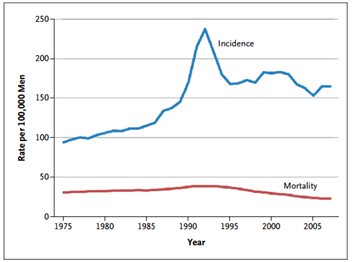
Let me get this straight. Twenty-five years ago, Urologists popularized a blood test for the early detection of a silent but very common and deadly cancer. With this tool in hand, called the PSA test, hundreds of millions of men have been screened worldwide since, changing the face of this cancer on the planet as...Continue reading
Prostate Cancer Detection and Diagnosis: Where Are We Now?
Prostate cancer is the second most common cancer in American men after skin cancer. In 2015 alone, there will be an estimated 220,800 new cases of prostate cancer, with a new case occurring every 2.4 minutes.[1] Prostate cancer can be a serious disease, but a majority of men diagnosed don’t actually die from prostate cancer,...
Oncotype DX
A new genetic test has recently become available called Oncotype DX. The test is made by Genomic Health and will now be available at Dr. Samadi’s Prostate Cancer Center in New York City. What is Oncotype DX? The Oncotype DX prostate cancer test is a biopsy-based genetic test that can be combined with other measures...Continue reading
Prostate Cancer: Cyberknife vs. Robotic Surgery
What is Cyberknife? Cyberknife is a form of stereotactic body radiation therapy (SBRT) and robotic-assisted radiosurgery (not actual surgery) that utilizes a computerized robot to automatically deliver high doses of radiation to the prostate gland. Fiducials are implanted into the body so that the Cyberknife machine can adjust to movement during each treatment. Who is...Continue reading
Treatment for BPH
Benign prostatic hyperplasia (BPH) is a condition that occurs in men usually over 50 years old and is characterized by an enlarged prostate. As men age, it is natural for the prostate to become enlarge. BPH is a noncancerous growth of the cells within the prostate gland. By age 60, more than half of men...
Treatment Options For Prostate Cancer
Active Surveillance/Watchful Waiting These are not types of treatment, but ways to monitor prostate cancer when it is very low-risk or slow growing. During active surveillance or watchful waiting, your doctor will keep track of the prostate cancer using various tests including a PSA blood test, digital rectal exam, and ultrasound. If the prostate cancer...Continue reading
PCA3 Test For Prostate Cancer
What is the PCA3 test? A PCA3 (prostate cancer gene 3) test is a simple urine test used to predict the likelihood of prostate cancer. Specifically, it is an additional tool used to determine whether a prostate biopsy is necessary. The PCA3 is specific for prostate cancer as the prostate cancer gene is only produced...Continue reading